
Happy Dinkers DUPR Games: Why You Can’t Choose Your Own Group
Your DUPR is 2.2, but you think you deserve to play in the stronger group?
That’s wonderful. Confidence is a good thing.
But here’s the problem.
Just because you believe you belong in a higher group doesn’t mean the organiser should put you there.
At Happy Dinkers 😊, we organise almost all our DUPR pickleball games by grouping players according to their DUPR ratings.
We use a color-coded system to make these groups easy to identify.
And occasionally, some players aren’t happy with the color assigned to them.
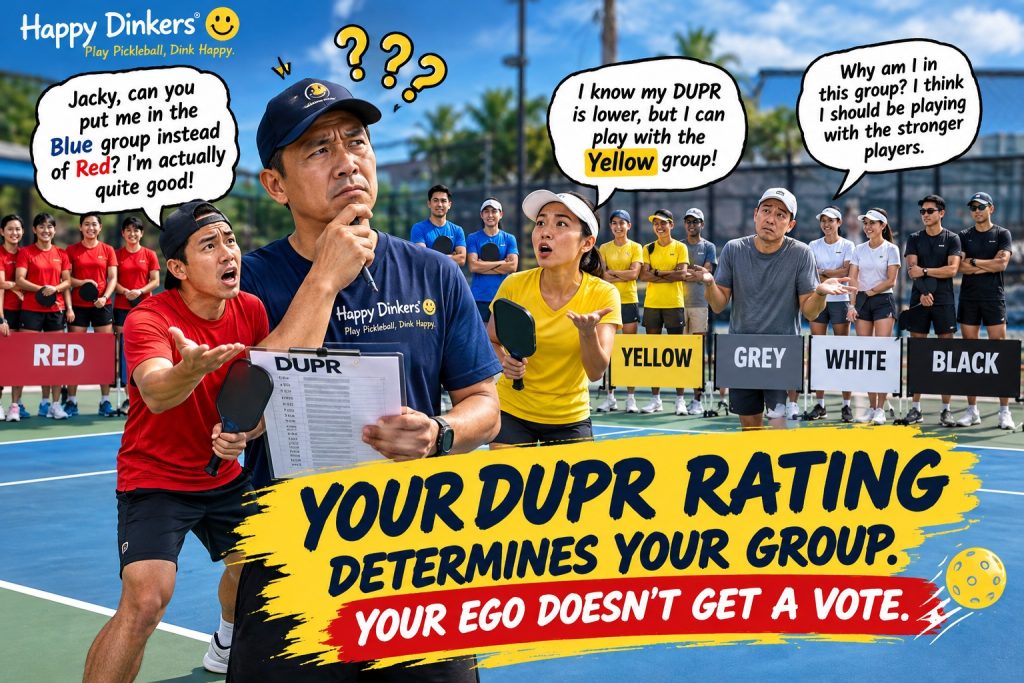
“Jacky, can you put me in the Blue group instead of Red? I’m actually quite good.”
“I know my DUPR is lower, but I can play with the Yellow group.”
“Why am I in this group? I think I should be playing with the stronger players.”
Sounds familiar?
Let me explain why these requests create problems, and why our DUPR grouping rules must apply to everyone.
1. How Our Color-Coded DUPR Groups Work
First, let’s explain how our grouping system works at Happy Dinkers.
For each DUPR game, we look at the ratings of the players who have registered and arrange them into groups according to their DUPR levels.
Our colors follow this order, from lower to higher-rated groups:
Happy Dinkers DUPR Grouping Order
RED
→
BLUE
→
YELLOW
→
GREY
→
WHITE
→
BLACK
From lower-rated to higher-rated players.
Important: We don’t necessarily use all six colors in every game.
Depending on how many players register and their DUPR ratings, we might have:
- Only Red and Blue groups.
- Three groups: Red, Blue and Yellow.
- Four or five groups.
- Or all six groups if the number and range of players justify it.
The number of groups depends on the actual participants in that session.
There is also no permanent DUPR rating attached to a particular color.
For example, a player assigned to Blue in one session might be assigned a different color in another session because the participating players and their ratings are different.
The colors are relative to the players in that particular game.
REMEMBER THIS:
Your group color is determined by your DUPR rating relative to the other players in that session.
It is not a group you get to choose based on personal preference.
2. “I’m Too Good for Red. Put Me in Blue.”
This is where the problems begin.
Imagine we’ve divided our players into Red and Blue groups.
The Red group consists of the lower-rated players, while Blue consists of the higher-rated players.
Then a Red group player messages me:
“Jacky, I think I’m too strong for Red. Can you move me to Blue?”
My first question is:
Based on what?
Because you think you’re good?
Because your friends say you’re good?
Because you once beat someone with a higher DUPR?
Because you don’t enjoy playing with lower-rated players?
None of these changes your current DUPR rating.
Maybe you really are better than your rating suggests.
I’m not denying that possibility.
But your personal assessment of your skills cannot become the standard for deciding your group.
Your DUPR determines your group.
Your ego doesn’t get a vote.
3. If I Move You from Red to Blue, What About Everyone Else?
Let’s continue with that example.
Player A is in Red.
He insists he’s strong enough for Blue.
I agree and move him.
Now Player B, whose DUPR is similar to Player A’s, asks:
“Why is he allowed to play in Blue while I’m still in Red?”
Fair question.
What am I supposed to say?
“Because I think Player A is better than you?”
Then Player C comes along.
And Player D.
And Player E.
Suddenly, everyone wants to negotiate their group.
Congratulations. Our DUPR grouping system has just become a popularity contest.
Instead of grouping players based on ratings, I’m now expected to judge everyone’s ability personally.
And if I approve one request but reject another, I’ll be accused of favoritism.
Quite rightly, too.
ONE EXCEPTION CREATES TEN MORE QUESTIONS.
If I make an exception for one player, I must be prepared to justify why every other player doesn’t receive the same treatment.
That’s why I prefer a simple policy.
Same rules. Same rating-based grouping system. No special treatment.
4. You’re Not the Only Player in the Game
Here’s something I wish more players understood.
When you ask to move from Red to Blue, or from Blue to Yellow, you’re usually thinking about one thing.
What YOU want.
But what about the other players?
What about the players who registered expecting to compete in a group determined by DUPR ratings?
What about those who accepted their assigned groups without complaining?
What about the players whose ratings are actually higher than yours?
Should I ignore all of them just because you believe you’re underrated?
Of course not.
Every player pays to participate.
Every player deserves fair treatment.
And every player should be able to trust that the organizer isn’t secretly changing the grouping criteria based on private messages.
Your desire to play in a higher group does not override everyone else’s right to fair and consistent grouping.
Remember, Happy Dinkers games are organized for the entire community.
Not for one player’s personal satisfaction.
5. Your Group Color Is Not a Status Symbol
Here’s another thing worth discussing.
Some players seem to treat group colors like status symbols.
They don’t want to be in Red because they think Red means they’re weak.
They want Blue because it sounds better.
Or Yellow.
Or Grey.
And perhaps one day, Black.
But let’s get something straight.
Red is not an insult. Blue is not a promotion. Black is not a VIP membership.
The colors are simply a practical way to divide players according to their ratings in that particular session.
Nothing more.
A player could be in Blue today and Red in another session if the overall field is stronger.
That doesn’t mean the player suddenly became worse.
It means the competition is different.
Your group color is not your identity.
And if you’re more concerned about the color of your group than improving your pickleball skills, perhaps you’re focusing on the wrong thing.
Stop chasing colors.
Start improving your game.
6. Think You’re Better Than Your DUPR? Prove It.
Let’s say your DUPR is 2.2, but you genuinely believe you play at 2.8.
Fantastic.
Then you have something to work towards.
Here’s what you should do:
- Keep playing rated matches. Give the rating system more results to work with.
- Focus on consistent performance. One great game doesn’t define your playing level.
- Improve your weaknesses. Work on your positioning, shot selection, consistency and teamwork.
- Let your results speak. Strong performances over time can help your rating better reflect your ability.
- Earn your place in higher-rated groups. Improve your DUPR instead of asking the organizer for special treatment.
Is DUPR perfect?
No.
Some players improve faster than their ratings change.
Some players have fewer recorded matches.
And some ratings might not fully reflect current playing ability.
But that’s not a reason to throw away the grouping system.
An imperfect rating system applied consistently is still fairer than letting everyone decide their own playing level.
WANT TO MOVE UP?
Improve your DUPR through competitive results. As your rating improves, your position relative to other players can improve too.
Earn your way up. Don’t negotiate your way up.
7. “But I Can Beat Players in the Higher Group!”
Maybe you can.
In fact, I wouldn’t be surprised.
Pickleball results aren’t always predictable.
Lower-rated players sometimes defeat higher-rated opponents.
That’s part of what makes the game exciting.
But here’s the important question.
Does beating a higher-rated player once automatically make you a higher-rated player?
Of course not.
And should I move everyone who claims to have beaten a stronger opponent into a higher group?
Imagine trying to organize a DUPR game that way.
Every player has a story.
Every player knows someone they once defeated.
Every player thinks they deserve a little more recognition.
If I start making decisions based on these stories, we’d spend more time arguing about groups than playing pickleball.
Your match results matter. Your selective memories of your best performances don’t determine your group.
8. Ambition Is Welcome. Entitlement Is Not.
I love seeing Happy Dinkers players improve.
I love seeing Red group players work their way into Blue.
And Blue players eventually becoming competitive enough to qualify for higher-rated groups.
That’s progress.
That’s something to celebrate.
But there’s a big difference between wanting to improve and demanding special treatment.
✓ AMBITION
“I’m currently in Red. I want to improve my DUPR so that I can qualify for Blue.”
✗ ENTITLEMENT
“I’m in Red, but I’m too good for Red. Put me in Blue because I deserve to be there.”
See the difference?
One player wants to earn a place in a stronger group.
The other expects the organizer to give it to them.
Ambition earns respect. Entitlement creates problems.
9. Why Fair DUPR Grouping Matters at Happy Dinkers
Organizing a DUPR game isn’t simply about filling courts with players.
It’s about creating an environment where people can enjoy meaningful, competitive matches.
Our color-coded grouping system helps us:
- Create more balanced matches.
Grouping players with similar ratings generally makes games more competitive and enjoyable. - Maintain transparency.
Players understand how the groups are organized. - Prevent favoritism.
Nobody receives special treatment simply because they know the organizer. - Reduce unnecessary disputes.
A consistent system leaves less room for arguments about who belongs where. - Encourage improvement.
Players have a reason to work on their game and improve their DUPR ratings.
More importantly, it means everyone is treated according to the same principles.
Could I make a player happy by moving them into a higher group?
Of course.
But should I make one person happy if doing so compromises fairness for everyone else?
Absolutely not.
I’d rather disappoint one player by enforcing a fair rule than disappoint an entire group by making an unfair exception.
10. Our Rule Is Simple: Respect Your Assigned DUPR Group
Let’s make our Happy Dinkers grouping policy absolutely clear.
Whether a game has two groups or six, the same principles apply.
- Groups are organized according to participants’ DUPR ratings.
- Group colors run from Red, Blue, Yellow, Grey, White to Black, in ascending rating order.
- Not all colors will necessarily be used in every session.
- The DUPR range for each color depends on the players registered for that session.
- Players do not get to choose higher groups simply because they believe they are better than their ratings.
- The organizer will not grant personal requests that undermine fair grouping.
It’s that simple.
If you’re unhappy with your assigned group, I understand.
But please understand my position too.
I’m responsible for organizing games that are fair to everyone, not just accommodating whoever messages me most persistently.
And no, repeatedly asking me to move you into another color isn’t going to make your DUPR rating increase.
If you want to challenge stronger opponents without rating-based grouping restrictions, look for suitable open-level games or social sessions.
But when joining our grouped DUPR sessions, please respect the system.
Final Word: Your DUPR Rating, Your Group. End of Discussion.
At Happy Dinkers 😊, we welcome players of all levels.
Whether you’re in Red, Blue, Yellow, Grey, White or Black, you’re part of our pickleball community.
There is nothing shameful about being assigned to a lower-rated group.
Everyone starts somewhere.
And everyone has opportunities to improve.
But please don’t confuse your ambition to improve with a right to demand special treatment.
If you’re assigned to Red, play your games.
If you want to qualify for Blue, work on improving your DUPR.
If you’re already in Blue and want to move higher, keep improving.
And if you’re convinced your rating doesn’t reflect your ability?
Then let your match results prove it.
Because the moment I allow players to select their groups according to their personal opinions, our entire grouping system becomes meaningless.
And that’s not how Happy Dinkers operates.
YOUR DUPR RATING
DETERMINES YOUR GROUP.
YOUR EGO DOESN’T
GET A VOTE.
Want to play in a stronger group?
EARN YOUR WAY UP.
Less arguing. More playing.
Let your results do the talking.
Sorry to hear you host receive such headache requests
Well said and thank you for taking such lengthy time sharing this.
Play one’s way up to get the necessary dupr rating system and don’t give Jacky and Fifi headache.