
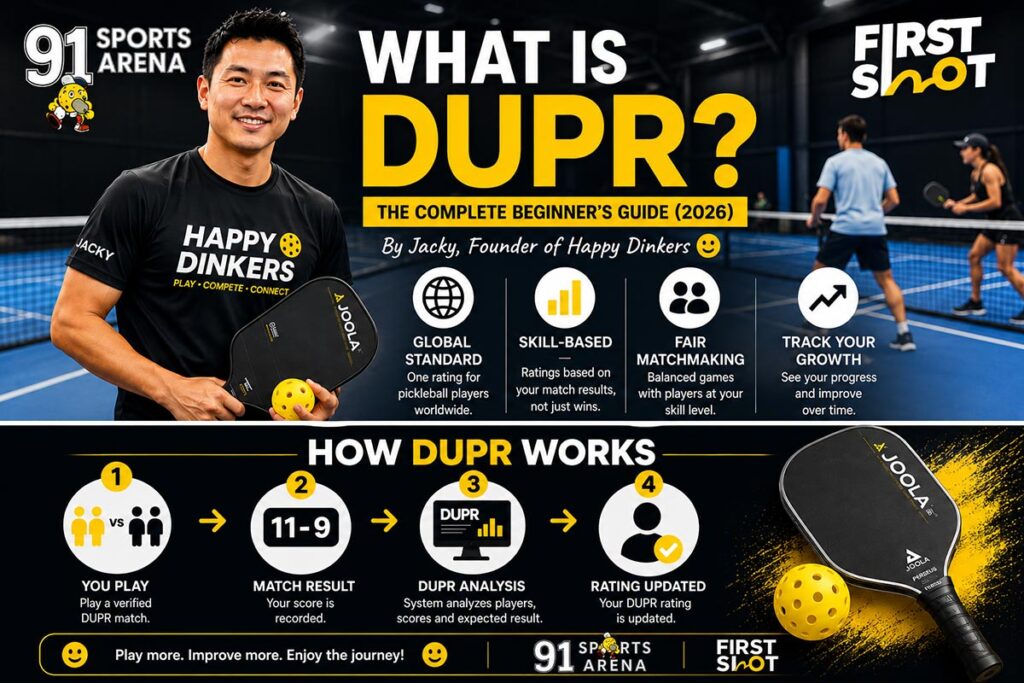
What is DUPR? The Complete Beginner’s Guide (2026)
If you’ve been playing pickleball for a while, you’ve probably heard people asking:
What’s your DUPR?
When I first started hosting pickleball games, very few players knew what DUPR was. Today, almost every serious pickleball player wants a DUPR rating.
At Happy Dinkers, I host DUPR games and social pickleball sessions almost every day at 91 Sports Arena and First Shot. If you want to see where those games appear, you can also browse our upcoming games, tournaments, and photo gallery.
One of the questions I get asked most often is:
Jacky, what exactly is DUPR, and should I get one?
The short answer is: yes.
Whether you’re a complete beginner or already competing in tournaments, having a DUPR rating is one of the best ways to measure your improvement.
In this guide, I’ll explain everything you need to know about DUPR in simple language.
What is DUPR?
DUPR stands for Dynamic Universal Pickleball Rating.
It is a global rating system designed to measure a player’s actual pickleball skill level.
Unlike traditional ratings that depend on where you play or who you know, DUPR attempts to create one universal rating system that plays out the same way everywhere.
Whether you’re playing in Malaysia, the United States, Australia, or Japan, a DUPR rating aims to represent the same level of ability.
Think of it as golf’s handicap, or chess’s ELO rating, but for pickleball.
Why was DUPR created?
Before DUPR, many tournaments relied on self-ratings.
The problem?
Many players accidentally overestimated or underestimated their own level.
This often resulted in very unbalanced matches.
DUPR solves this by using actual match results rather than opinions.
The more verified matches you play, the more accurate your rating becomes.
How does DUPR work?
Every time you play a verified DUPR match, the system analyzes:
- Who you played
- Your partners
- Your opponents
- The score
- The expected result
- The actual result
If you perform better than expected, your rating may increase.
If you perform worse than expected, your rating may decrease.
It isn’t simply about winning or losing.
For example:
If a 1.5 player loses 11-9 against much stronger players, DUPR may still see that as a useful result.
That means your rating can improve even if your team does not win, depending on the match context.
What is a good DUPR rating?
This is probably the most common question I receive.
Although every player develops differently, here’s a rough guide.
| DUPR | Typical Player |
|---|---|
| Below 2.5 | Beginner |
| 2.5–3.0 | Improving recreational player |
| 3.0–3.5 | Consistent club player |
| 3.5–4.0 | Strong intermediate player |
| 4.0–4.5 | Advanced tournament player |
| 4.5+ | Highly competitive player |
| 5.0+ | Elite player |
Don’t become obsessed with the number.
Instead, think of DUPR as a progress tracker.
Is DUPR only for tournament players?
Absolutely not.
In fact, I encourage beginners to start playing DUPR games earlier than they think.
Many new players worry:
I’m not good enough.
Everyone starts somewhere.
Playing DUPR games gives you:
- A benchmark
- Useful match pressure
- Better opponents
- Better partners
- Faster improvement
At Happy Dinkers, I regularly see beginners improve dramatically within just a few months because they consistently play organized DUPR matches.
If you want to understand where those matches happen, check our upcoming games and tournaments pages.
How do I get my first DUPR rating?
Getting started is simple:
- Create a free DUPR account.
- Join an organized DUPR session.
- Play your matches.
- Wait for the results to be submitted.
Once enough verified results are recorded, your rating will start appearing.
The first few matches may cause larger rating changes because the system is still learning your actual skill level.
That is normal.
As you play more, your rating becomes more stable.
Why do some players’ ratings move more than others?
This is completely normal.
When you first begin, the system has less information about your playing ability.
As a result, your rating may change quite a bit after each match.
After you’ve played many more matches, the rating generally becomes more stable.
This is why experienced players often see smaller changes after a single session.
Should I avoid stronger players to protect my DUPR?
Definitely not.
This is probably the biggest myth I hear.
Some players become so worried about their rating that they stop challenging themselves.
That’s the wrong mindset.
Playing stronger opponents helps you:
- Learn faster
- Improve your decision-making
- Develop consistency
- Discover weaknesses
Ironically, players who focus on improving instead of protecting their rating usually end up with higher DUPR ratings over time.
If you want to meet players at different levels, browse our upcoming games or read Beginner to DUPR 3.0: What New Players Should Focus On.
Does losing always reduce my DUPR?
Not necessarily.
Many people assume:
- Win = rating goes up
- Lose = rating goes down
It doesn’t always work that way.
The system compares your actual performance against its expectations.
If you perform better than expected—even in a loss—you may still see a rating change in your favor.
That’s why the same match result, but against different opponents, can produce different outcomes.
Why I encourage players to play DUPR
After organizing thousands of pickleball games, I’ve noticed something interesting.
When players first get DUPR ratings, they care a lot about the number.
Why?
- They play more regularly.
- They take practice seriously.
- They care about consistency.
- They care about better partners.
- They care about fair matches.
At Happy Dinkers, I regularly see beginners improve faster when they stop asking, “Did I win today?” and start asking, “What did I learn today?”
That mindset makes a huge difference.
My advice to beginners
If you’re just getting started, don’t wait until you’re “good enough.”
- Join social games.
- Meet new players.
- Try organized DUPR sessions.
- Play with better players.
- Keep showing up.
Every strong player was once a beginner too.
If you want to see the kind of sessions we run, take a look at our upcoming games, tournaments, and photo gallery.
Frequently Asked Questions
-
Is DUPR free?
Yes. Creating a DUPR account is free.
-
How many matches should I play?
The more verified matches you play, the more reliable your rating becomes.
-
Can my DUPR go down?
Yes. That is possible, especially if you underperform against your expected level.
-
Should beginners have a DUPR?
Yes. Beginners benefit the most because they can clearly track their progress.
Final Thoughts
At Happy Dinkers, our goal isn’t just to organize pickleball games.
We want to help players become better players while having fun and making new friends.
Whether you’re chasing your first DUPR rating or aiming for your next milestone, remember that every match is a chance to learn.
If you can’t wait to play, browse our upcoming games, tournaments, or visit 91 Sports Arena and 91 Café to see what makes our community special.
Happy Dinking!
Related Happy Dinkers Reading
- How to Join Happy Dinkers DUPR Games in Malaysia
- Beginner to DUPR 3.0: What New Players Should Focus On
- 91 Sports Arena: A Home Court for Happy Dinkers Games
- First Shot Pickleball Sessions with Happy Dinkers
- Clash Tournament #2 Recap: Why This Happy Dinkers Event Mattered
- Mini Mini Tournaments: Friendly Competition for Every Level
- Happy Dinkers Photo Gallery