
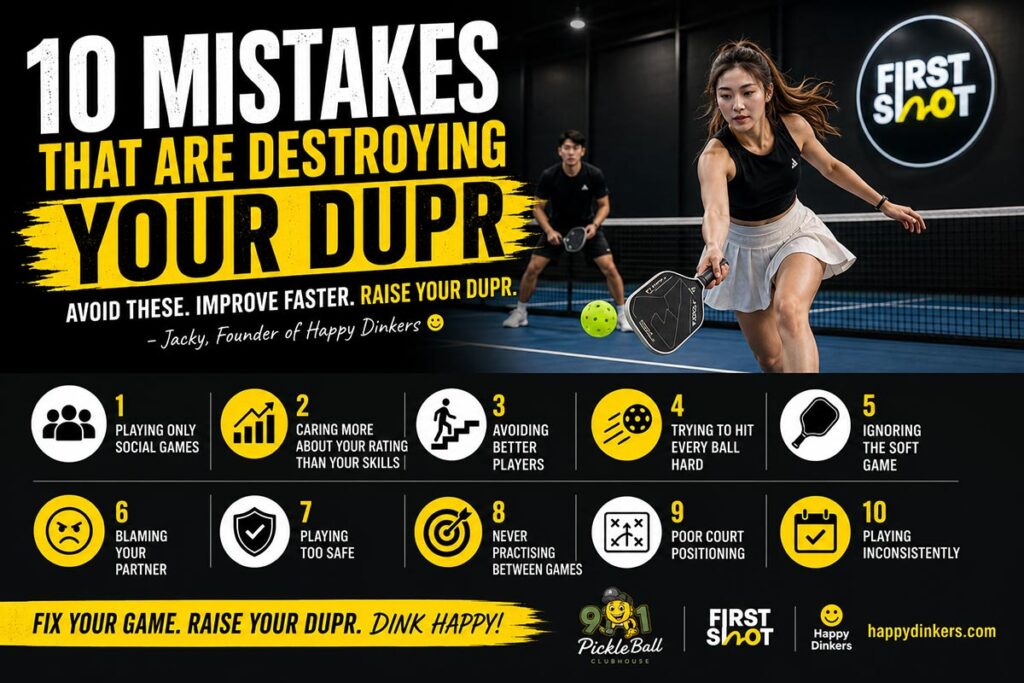
10 Mistakes That Are Destroying Your DUPR (And How to Fix Them)
If you’ve been playing pickleball regularly but your DUPR just doesn’t seem to improve, you’re not alone.
At Happy Dinkers, I host DUPR games and social sessions every day, mainly at 91 Sports Arena and First Shot, plus the occasional session at other good pickleball venues around Malaysia. So I get to see a lot of players up close, and after watching thousands of matches, I can tell you this: most DUPR problems are not really about talent. They are usually about habits.
That is good news, because habits can be changed.
If you are new to DUPR, you may want to start with our beginner guide first:
👉 What is DUPR? The Complete Beginner’s Guide (2026)
You can also read:
👉 How to Increase Your DUPR Rating Faster
This article is about the common mistakes that quietly hold your DUPR back, and what you can do instead.
1. Playing Only Social Games
Social games are great. I love them too.
They are fun, relaxed, and a good way to meet people. But if social games are the only type of pickleball you play, your DUPR may improve more slowly than you expect.
Competitive DUPR matches teach you things that casual games often do not:
- how to handle pressure
- how to choose better shots
- how to stay disciplined during long points
- how to make smarter decisions when the score gets tight
At Happy Dinkers, the players who improve the fastest usually mix both: social games for enjoyment, and DUPR games for challenge and growth.
If you want to find those sessions, check our upcoming games and our tournaments.
2. Caring More About Your Rating Than Your Game
This is a big one.
The players who obsess too much about their DUPR rating often improve the slowest, because they start playing not to learn, but to protect a number.
That usually leads to hesitation. They stop trying new shots, avoid stronger opponents, and play too safely.
The better approach is simple: focus on becoming a better pickleball player. When your skills improve, your DUPR usually follows.
3. Avoiding Stronger Players
I see this all the time.
Some players only want games they think they can win. But if you keep avoiding stronger players, you also avoid the very matches that help you improve the most.
Playing stronger opponents shows you:
- where your weaknesses really are
- how better players build points
- what good court positioning looks like
- how much patience matters in pickleball
If you want your DUPR to rise, challenge yourself more often.
4. Trying to Hit Every Ball Hard
Power is exciting. But power alone does not win enough points at DUPR level.
Many players think they need to end every rally with a winner. In reality, the players who win more consistently are usually the ones who stay patient.
They:
- dink with purpose
- move their opponents around
- wait for a high ball
- attack only when the chance is right
In pickleball, control often beats raw power.
5. Ignoring the Soft Game
The soft game matters a lot more than many people think.
The kitchen is where many points are won or lost, yet a lot of players still spend most of their training time on drives and very little time on:
- dinks
- resets
- drops
- blocks
If you want to move up in DUPR, you cannot ignore those shots. They are often the difference between an average player and a more complete one.
That is also why so many of our sessions at 91 Sports Arena and First Shot are built around proper match play and real game situations.
6. Blaming Your Partner
We have all had tough games with tough partners. That happens.
But if every loss becomes your partner’s fault, you stop looking at your own game. And once that happens, improvement slows down.
Instead, ask better questions:
- Could I have covered better?
- Was my positioning good enough?
- Did I create enough pressure?
- Did I communicate clearly?
The players who improve fastest are usually the ones who stay honest with themselves.
7. Playing Too Safe
Some players become so afraid of mistakes that they stop trying to improve.
They never really test:
- third-shot drops
- ATPs
- speed-ups
- topspin serves
- aggressive returns
But improvement always requires a little discomfort.
Yes, mistakes will happen. That is part of learning.
8. Never Practising Between Games
Playing matches is important, but it is not the same as practising.
You would not expect to improve in golf without going to the driving range. Pickleball is the same.
Even 20 to 30 minutes of focused practice each week can improve:
- serves
- returns
- dinks
- volleys
- footwork
If you want to play more meaningful matches, keep an eye on our game schedule and our latest updates.
9. Poor Court Positioning
A lot of players focus only on the shot. Better players focus on the shot and where they are standing.
Common positioning mistakes include:
- standing too far from the kitchen
- leaving the middle open
- moving backwards too early
- not moving together with your partner
Good positioning often creates easy points without needing a better shot.
10. Playing Inconsistently
Some players disappear for weeks, then suddenly play a lot in one weekend.
That does not usually work well for improvement.
The players who improve fastest usually play consistently, even if it is just two quality sessions a week.
Consistency builds:
- muscle memory
- confidence
- decision-making
- better teamwork
What I Notice at Happy Dinkers
After watching so many DUPR games, one thing is very clear to me: the players who improve the fastest are not always the most athletic ones.
They are usually the ones who:
- show up regularly
- ask questions
- play stronger opponents
- accept feedback
- keep learning
- enjoy the process
That is why their DUPR improves. They are building a better game, not just chasing a higher number.
If you want to see the kind of sessions and people behind that progress, take a look at our photo gallery and some of our tournaments.
My Advice
If you are serious about improving your DUPR, do not obsess over the number.
Focus on becoming a more complete pickleball player.
Every session is a chance to improve one part of your game.
Small improvements add up over time. When your game gets better, your DUPR usually does too.
I hope to see you at one of our Happy Dinkers sessions soon. Whether it is at 91 Sports Arena, First Shot, or another venue, my goal is always the same: help players improve, enjoy the game, and feel part of a great pickleball community.
If you like to improve and enjoy good food after a game, you may also want to read about our 91 Café player perk.
Happy Dinking! 😊
Frequently Asked Questions (FAQ)
A few quick answers to common DUPR questions.
1. Does losing always reduce my DUPR?
No. DUPR looks at more than just winning or losing. It also considers the expected result and the match context. A close loss against much stronger players can sometimes be better for your DUPR than a comfortable win against weaker opponents.
2. Is it better to play stronger or weaker players?
In general, playing stronger players helps you improve faster because you are exposed to better shot quality, better strategy, and better consistency. A mix of both is ideal.
3. Can social games improve my DUPR?
Social games improve your skills, confidence, and experience. However, only officially submitted DUPR matches affect your actual DUPR rating.
4. Why has my DUPR stopped increasing?
Usually because your current skill level is close to your rating. The answer is not to chase easy wins; it is to keep improving your game.
5. Should I avoid DUPR games if I am worried about my rating?
No. Avoiding competition usually slows down improvement. DUPR games are one of the fastest ways to become a better player.
6. How often should I play to improve my DUPR?
Four to five quality sessions every week is a very good target. Consistency matters more than occasional big sessions.
7. What’s the biggest mistake beginners make?
Trying to hit winners too often. At beginner and intermediate levels, most points are won through consistency, patience, and smart shot selection.
8. Does practising matter more than playing matches?
You need both. Matches give you experience, while focused practice helps you build the specific skills that carry over into better match performance.
9. Should I only partner with stronger players?
No. Playing with different partners helps you build communication, adaptability, and teamwork, which are all important in pickleball.
10. What’s the fastest way to improve my DUPR?
Play consistently, practise your soft game, challenge stronger opponents, learn from every match, and stay focused on improving your overall game. DUPR is a reflection of how well you play, not something you can sustainably hack.