

How Many DUPR Matches Do You Need Before Your Rating Is Accurate?
If there’s one question I hear almost every day while hosting games at Happy Dinkers, it’s this:
“Jacky, I’ve only played 5 DUPR matches. Is my rating accurate yet?”
It’s a great question.
Some players panic after losing their first few matches. Others celebrate when they jump to 3.8 after only three games.
The truth is: neither rating is likely to represent your true playing level yet.
After hosting thousands of DUPR matches at 91 Sports Arena, First Shot, and many other pickleball venues, I’ve seen how DUPR ratings evolve over time.
Let’s look at how many matches you really need before your DUPR rating becomes trustworthy.
The Short Answer
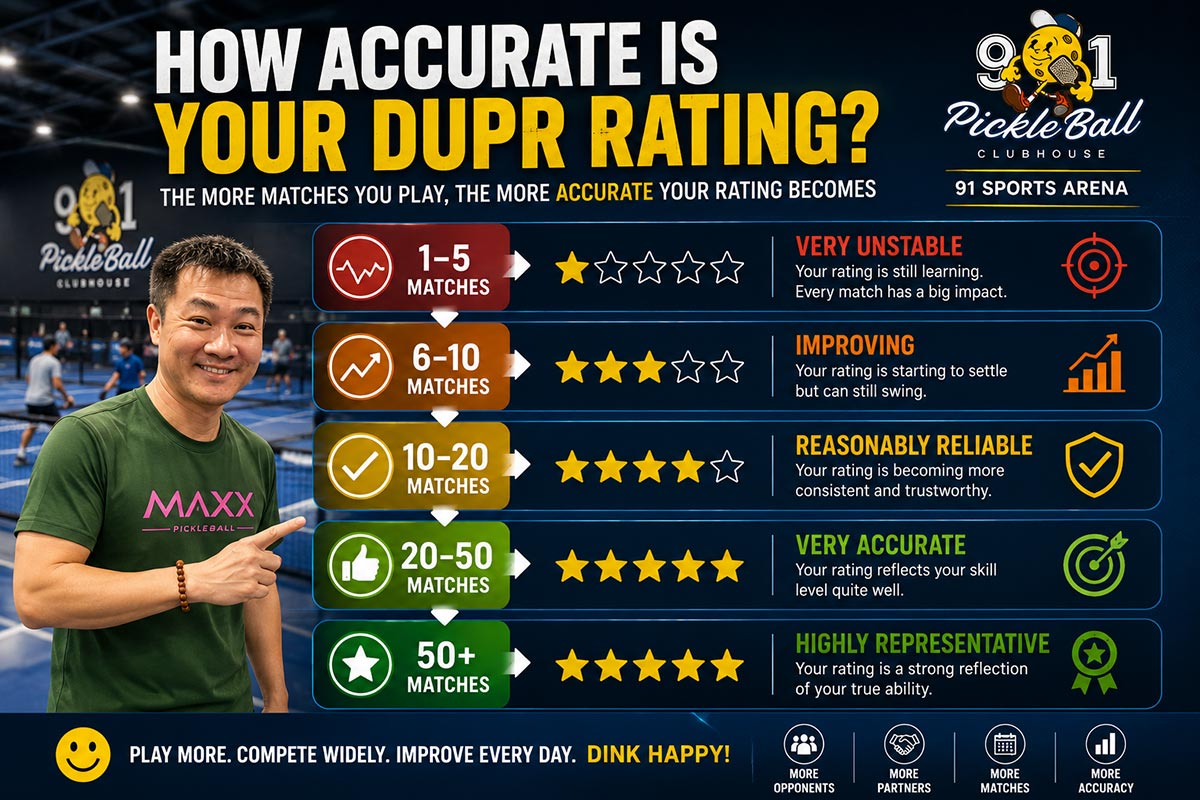
There isn’t one magical number. However, based on experience, here’s a useful guideline:
| Number of DUPR Matches | Rating Accuracy |
|---|---|
| 1-5 | Very unstable |
| 6-10 | Starting to settle |
| 10-20 | Reasonably reliable |
| 20-50 | Quite accurate |
| 50+ | Very representative of your skill |
Think of your first few matches as introducing yourself to DUPR. The system is still learning who you are. Only after playing a variety of opponents does it begin understanding your actual level.
Why Doesn’t DUPR Become Accurate Immediately?
Imagine trying to judge someone’s pickleball ability after watching only one game.
Maybe they:
- had a bad day
- were nervous
- played with an unfamiliar partner
- played against someone far stronger
- were recovering from an injury
You wouldn’t know their real level.
DUPR works similarly. It needs enough information before making reliable conclusions.
More matches mean:
- more opponents
- more playing styles
- different partners
- different scores
- better statistical confidence
This naturally produces a much more stable rating.

Every Match Adds Information
A common misunderstanding is:
“I’ve already played ten matches against my friend.”
While those matches still help, they’re not as informative as playing many different opponents.
The strongest DUPR profiles usually include:
- different partners
- different opponents
- different venues
- mixed playing styles
This gives the algorithm a much clearer picture of your ability.

Variety Is More Important Than Quantity
This surprises many players.
Twenty matches against the same three friends isn’t nearly as valuable as twenty matches against twenty different players.
The wider your competition pool becomes, the more accurate your rating tends to be.
That’s one reason why I encourage players to join different DUPR sessions throughout the week.
At Happy Dinkers, you’ll often meet new opponents every session. That diversity benefits both your game and your rating.
Why Ratings Change So Much Early On
Many new players experience something like this:
- Match 1:
3.65
- Match 2:
3.18
- Match 3:
3.52
- Match 4:
2.95
- Match 5:
3.34
They assume something is broken.
Actually, this is perfectly normal.
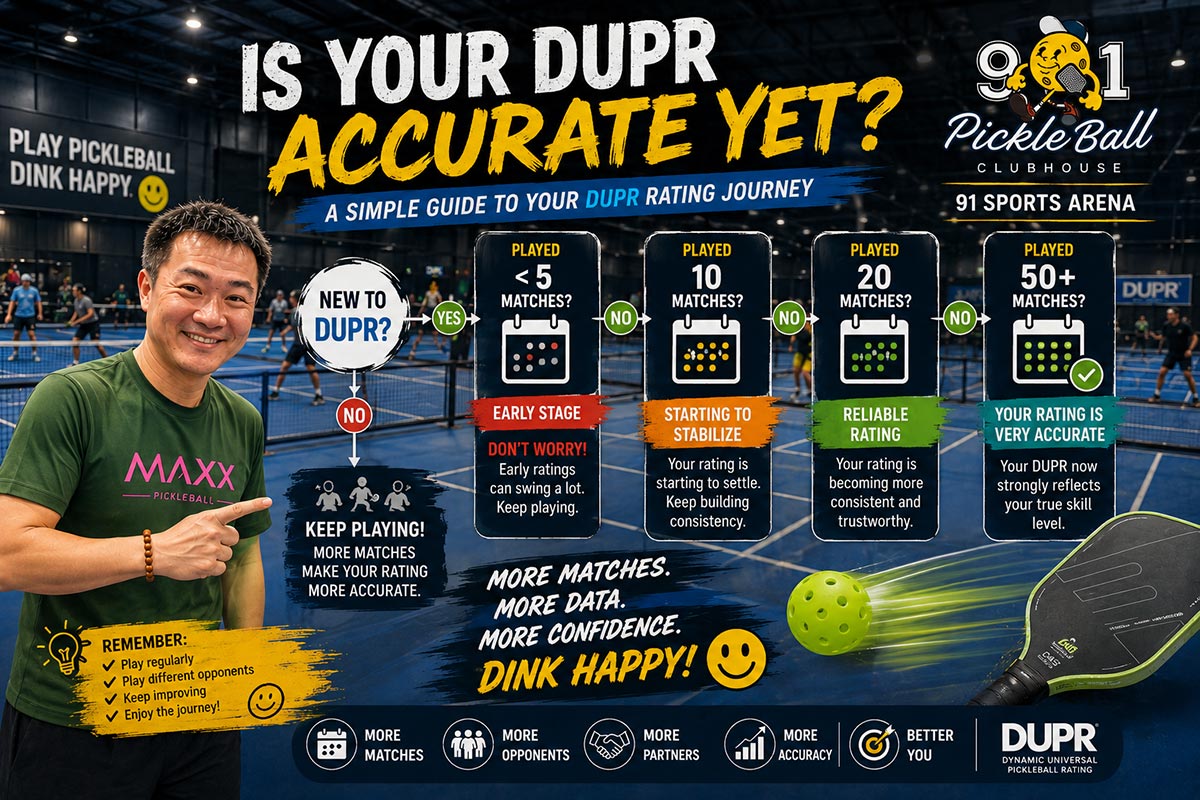
With only a handful of results, every match carries significant weight. As more matches accumulate, each individual match has less impact. Eventually your rating starts moving much more gradually.
Think of DUPR Like Google Maps
I like using this analogy.
When Google Maps first starts calculating your route, it has only limited information. As you continue driving, it gathers:
- traffic
- speed
- road conditions
- detours
The estimated arrival time becomes increasingly accurate.
DUPR behaves similarly. Every completed match gives it more data. Over time, your rating becomes more precise.
Playing Better Players Helps
Another myth I often hear is:
“I should only play weaker players so my rating goes up.”
Actually, that’s usually the opposite of what helps.
Playing stronger opponents teaches DUPR much more about your level. Even when you lose, a competitive performance can provide valuable information.
That’s why I always encourage our Happy Dinkers community to mix with players of different skill levels. Everyone benefits.
What Makes a DUPR Rating More Accurate?
Several factors contribute.
Consistent Play
Players who disappear for months and return occasionally may see more fluctuations than players who compete regularly.
Different Partners
Playing with multiple partners gives DUPR more independent data points.
Different Opponents
Facing new opponents improves confidence in your rating.
Honest Results
Always submit accurate scores. Never manipulate results simply to protect or boost your rating.
Competitive Matches
Real competitive games provide better information than matches where players aren’t trying.
Can Too Many Easy Matches Hurt Accuracy?
Sometimes.
If nearly all your matches are against beginners, DUPR has limited information about how you perform against stronger players. Likewise, if every match is against professionals, it may also struggle to estimate your level accurately.
The healthiest profile usually includes a variety of opponents near your own skill level, along with some stronger and weaker players.
Why Happy Dinkers Is Great for Building an Accurate DUPR
One advantage of hosting games every day is that our player pool is constantly changing.
At Happy Dinkers, you may play against:
- experienced tournament players
- improving intermediates
- new DUPR players
- visiting players
- players from different clubs
That variety naturally helps DUPR understand your level more accurately.
Whether we’re playing at 91 Sports Arena, First Shot, or another great venue, our goal is always the same:
Help players improve while having fun.
If you’re a court owner looking to grow your DUPR community, I’d also love to collaborate. Happy Dinkers regularly hosts games at multiple venues, and we’re always excited to work with quality pickleball facilities that share our passion for growing the sport.
Don’t Chase the Number
One of the biggest mistakes I see is players checking DUPR after every match.
Instead, ask yourself:
- Am I improving?
- Am I making fewer mistakes?
- Am I moving better?
- Am I communicating better with partners?
- Am I winning more rallies against stronger players?
If the answer is yes, your DUPR will usually take care of itself.
My Recommendation
If you’re new to DUPR, don’t judge your rating after five matches.
Aim for:
- at least 10 matches before taking it seriously
- around 20 matches before comparing yourself with friends
- 50+ matches if you want a highly reliable reflection of your ability
Remember: DUPR is a marathon, not a sprint.
The players with the most accurate ratings are usually those who simply keep showing up, playing honestly, and enjoying the game.
That’s exactly what we encourage every day at Happy Dinkers.
Continue Your DUPR Journey
If you’re new to DUPR, these guides will help you understand the system even better:
- What is DUPR? The Complete Beginner’s Guide (2026)
- How to Increase Your DUPR Rating Faster
- 10 Mistakes That Are Destroying Your DUPR (And How to Fix Them)
- How DUPR Actually Calculates Your Rating (2026)
- DUPR vs Self Rating: Which One Matters? (2026 Guide)
You can also explore our latest games, tournaments, and photo gallery on this website. We’d love to see you on court!
Frequently Asked Questions (FAQ)
1. How many DUPR matches do I need before my rating is accurate?
Most players will notice their rating becoming reasonably stable after around 10-20 matches. After 50 or more matches, it usually provides a much more reliable reflection of your true skill level.
2. Why does my DUPR rating change so much after every match?
Early in your DUPR journey, each match contributes a large amount of new information. As you play more matches, each individual result has a smaller impact, making your rating more stable.
3. Can one bad match ruin my DUPR?
Not permanently. A single poor performance may affect your rating slightly, especially if you’re new, but consistent results over time are much more important.
4. Should I avoid playing stronger players?
No. Playing stronger opponents often helps both your improvement and the accuracy of your DUPR rating. Competitive matches provide valuable data, even if you don’t win.
5. Does playing with different partners improve DUPR accuracy?
Yes. Playing with a variety of partners and opponents gives DUPR a broader picture of your skill level, which generally leads to a more accurate rating.
6. How often should I play DUPR matches?
Regular play is ideal. Consistent participation helps keep your rating current and better reflects your present ability.
7. Can social games count toward DUPR?
Yes, provided they are organized as official DUPR sessions and the results are submitted correctly. Many Happy Dinkers sessions include official DUPR matches.
8. Is a player with 200 matches always better than someone with 20 matches?
Not necessarily. A higher match count usually means the rating is more reliable, but the actual skill level is determined by the rating itself, not by the number of matches played.
9. Why is my friend’s DUPR more stable than mine?
They may have played significantly more matches or competed against a wider range of opponents. More data generally leads to greater rating stability.
10. What’s the fastest way to build an accurate DUPR profile?
Play regularly, compete against a variety of opponents, partner with different players, submit honest scores, and focus on improving your game rather than chasing a specific rating.
Final Thoughts
Whether you’re just starting your DUPR journey or aiming to break into the next rating level, remember that patience and consistency are key. Every match teaches you something, and every game helps DUPR understand your true ability a little better.
I hope to see you at one of our upcoming Happy Dinkers sessions at 91 Sports Arena, First Shot, or another fantastic venue. And if you’re a court owner interested in hosting more active DUPR events, feel free to reach out – I’m always happy to explore new collaborations and help grow the pickleball community together.