

DUPR vs Self Rating: Which One Matters? (2026 Guide)
One of the questions I hear almost every day is whether a player should trust their DUPR rating or their own self-rating. After hosting thousands of pickleball games through Happy Dinkers, I’ve learned that many players get confused by the difference.
Should you trust the number on the screen? Should you trust your own judgement? And which one do tournament organizers actually care about?
The answer is simple: both matter — but for different reasons.
What players ask me all the time
“Jacky, my DUPR is 2.9, but I think I’m actually a 3.5 player.”
And sometimes I hear the opposite
“My DUPR says 3.8, but I don’t think I’m that strong.”
In this guide, I’ll explain how I look at DUPR and self-rating when organizing games at 91 Sports Arena, First Shot, HyprGround S19, and other pickleball venues we work with.
DUPR vs Self Rating: The Short Answer
- Self-rating is useful when a player is new and has no rated match history yet.
- DUPR becomes much more reliable once a player has enough quality matches.
- Good organizers use both so they can place players more fairly.
Improvement comes from playing better players, not protecting your rating.
What Is a Self Rating?
A self-rating is exactly what it sounds like. You estimate your own playing level.
For example:
- Beginner
- 2.5
- 3.0
- 3.5
- 4.0
- 4.5+
Unlike DUPR, there is no official calculation. You are simply judging your own ability based on your experience, confidence, and the players you usually play with.
Many clubs ask new players for their self-rating because they may never have played an officially rated match before.
If you want to understand DUPR itself first, you may also want to read:
- What Is DUPR? The Complete Beginner’s Guide (2026)
- How to Increase Your DUPR Rating Faster
- How DUPR Calculates Your Rating
What Is DUPR?
DUPR (Dynamic Universal Pickleball Rating) is an international rating system that calculates your skill level using actual match results.
Instead of asking,
“How good do you think you are?”
DUPR asks,
“Who did you actually play, and what happened?”
It considers factors like:
- Opponents’ ratings
- Partners’ ratings
- Match scores
- Expected outcome
- Actual outcome
The more quality matches you play, the more accurate your rating becomes.
Why Self Ratings Are Often Wrong
Here’s something I’ve noticed after organizing games for thousands of players: most people do not intentionally rate themselves incorrectly. Instead, they simply do not have enough context yet.
For example, a player might dominate among close friends, and everyone tells them:
“You’re easily a 4.0.”
Then they join a larger community event and realize the average 4.0 player is much stronger than expected.
The opposite also happens. Some players are humble and describe themselves as:
“Probably around 2.5.”
After watching them play, they are clearly closer to 3.5.
Self-rating is affected by:
- Confidence
- Experience
- Playing environment
- Local competition
- Personal expectations
That is why self-ratings vary so much.
Why DUPR Is More Objective
DUPR removes most of the guessing. Instead of opinions, it uses data.
For example:
- Player A beats several 3.5 players.
- Player B loses closely to several 4.0 players.
Even if neither player thinks they are especially strong, the results reveal their actual level much better than self-assessment alone.
That is why tournaments increasingly use DUPR.
Does DUPR Always Tell the Whole Story?
No. This is something many players misunderstand.
A DUPR rating is only as good as the data behind it.
For example:
- One player has only four rated matches.
- Another player has over 300.
Whose rating is likely to be more accurate? Usually the second player.
I’ve also seen players whose ratings do not fully reflect their current level because:
- They improved rapidly.
- They returned after a long break.
- Most of their matches were against the same group of players.
- Their recent form is much stronger than their older results.
That is why experienced organizers do not rely on one number alone.
When Self Rating Is Useful
Self-rating still has an important role, especially when players are new.
If you have never played a DUPR match before, your self-rating helps organizers place you into suitable games.
At Happy Dinkers, we also look at:
- Playing experience
- Movement
- Shot consistency
- Match awareness
- Court positioning
After a few sessions, we usually have a much clearer picture.
When DUPR Matters More
Once you have built a reasonable match history, DUPR becomes much more useful.
That is especially true for:
- DUPR sessions
- DUPR tournaments
- Club leagues
- Skill-based ladders
- Competitive events
Using an objective rating creates fairer games. Players enjoy closer matches, and nobody likes winning 13–1 or losing 2–13 every game.
Balanced games are simply more fun.
Why I Don’t Judge Players by Rating Alone
This surprises many people.
When someone joins Happy Dinkers, I do not only look at their DUPR. I also watch how they play.
Some things ratings do not immediately show include:
- Communication
- Sportsmanship
- Consistency
- Court awareness
- Teamwork
- Decision making
- Adaptability
I’ve seen players with lower DUPR ratings who become excellent partners because they make smart decisions and communicate well.
I’ve also seen higher-rated players who still have weaknesses they can improve.
A number is helpful — but it does not tell the entire story.
Common Reasons DUPR and Self Rating Don’t Match
1. Not Enough Matches
New DUPR ratings change quickly. A handful of matches rarely tells the full story.
2. Rapid Improvement
Some players improve dramatically within a few months, so their rating may simply be catching up.
3. Strong Local Competition
If your regular opponents are very strong, your rating might appear lower than your actual ability compared with players from other communities.
4. Limited Opponent Variety
Playing the same group repeatedly gives DUPR less information than competing against a wider range of players.
5. Honest Self-Reflection
Some players judge themselves based on today’s performance, while DUPR reflects performance over many matches.
Which Should Tournament Organizers Use?
From my experience, the best answer is:
Use both.
DUPR provides objective data. Self-rating provides additional context. Together they help create fairer games.
For newer players, self-rating is often the only information available. For experienced players, DUPR becomes increasingly valuable.
My Advice to New Players
If you are just starting your pickleball journey, do not worry too much about the number beside your name.
Instead, focus on:
- Learning proper technique.
- Playing regularly.
- Challenging stronger players.
- Enjoying the game.
- Building consistent habits.
Your DUPR will naturally become more accurate over time.
Trying to “protect” your rating usually slows your improvement. Playing more — and learning from every match — is what really helps.
Why Happy Dinkers Uses Both
At Happy Dinkers, our goal is not simply to organize games. Our goal is to create enjoyable, competitive, and welcoming sessions for everyone.
Whether you are joining us at:
- 91 Sports Arena
- First Shot
- HyprGround S19
- or another great pickleball venue,
we try to match players as fairly as possible.
We host both social games and official DUPR sessions, giving players opportunities to enjoy the sport while steadily improving.
If you are a pickleball court owner looking to attract more players through professionally organized games or DUPR events, I would also love to hear from you. Happy Dinkers regularly collaborates with venues, and we are always open to working with great pickleball facilities.
If you want to see what is happening now, check our upcoming games, browse our tournaments, or look through the photo gallery.
Final Thoughts
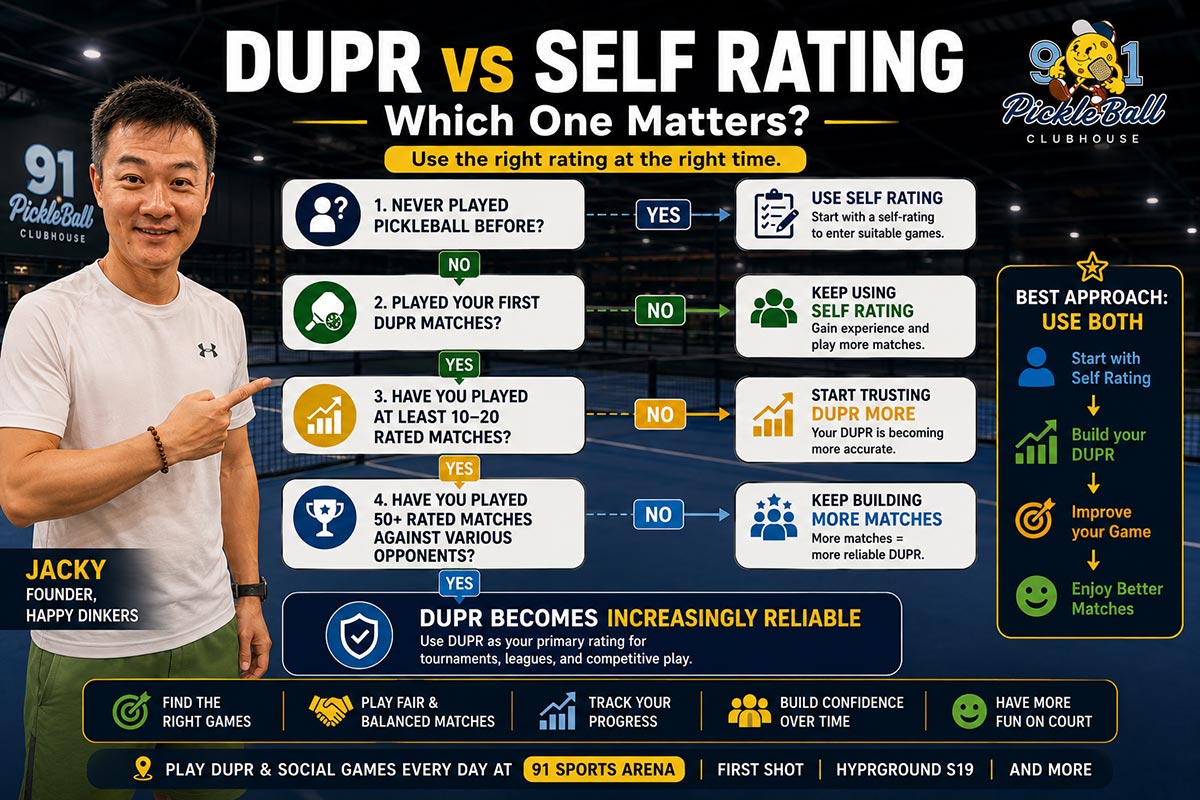
So… which matters more?
If you are new to pickleball, self-rating helps you get started.
As you build more match history, DUPR becomes the more reliable measure of your competitive level.
Neither system is perfect on its own. Together, they paint a much clearer picture.
At the end of the day, the goal is not to chase a number. It is to become a better player, enjoy closer matches, and be part of a great pickleball community.
If you would like to experience well-organized social games or official DUPR sessions, come join us at Happy Dinkers. We would love to see you on court.
Frequently Asked Questions
Here are the most common questions I hear from players who are trying to make sense of DUPR and self-rating.
1. Is DUPR more accurate than a self-rating?
Generally, yes. DUPR is based on actual match results rather than personal opinion. However, ratings become much more reliable after you have played a reasonable number of matches.
2. Can my self-rating be higher than my DUPR?
Yes. This is quite common, especially if you are improving quickly or have only played a small number of rated matches.
3. Why is my DUPR lower than I expected?
Possible reasons include limited match history, strong opponents, recent losses, or playing mostly against the same group of players. Your rating often becomes more accurate as you play more matches.
4. Can I join Happy Dinkers if I do not have a DUPR rating?
Absolutely. Many new players start with a self-rating, and we will help place you in suitable games while you build your DUPR.
5. Do tournaments use DUPR or self-rating?
Many competitive tournaments now use DUPR, although some beginner-friendly events still rely on self-ratings or a combination of both.
6. How many DUPR matches do I need before my rating becomes reliable?
There is not a fixed number, but the more quality matches you play against a variety of opponents, the more stable and representative your rating becomes.
7. Can my DUPR change even if I win?
Yes. DUPR considers who you played, expected results, and match scores. Winning does not always guarantee a higher rating.
8. Should I avoid playing stronger opponents to protect my DUPR?
No. Playing stronger players is one of the fastest ways to improve your skills, and competitive matches provide valuable data for your rating.
9. Is it okay to adjust my self-rating over time?
Yes. As your skills improve and you gain more experience, it is perfectly reasonable to update your self-rating to better reflect your current level.
10. Where can I play official DUPR matches in Malaysia?
Happy Dinkers regularly hosts official DUPR sessions at 91 Sports Arena, First Shot, HyprGround S19, and occasionally at other quality pickleball venues. Check the upcoming games on HappyDinkers.com to join a session near you.
Related Articles
To continue learning about DUPR, here are a few more Happy Dinkers guides worth reading:
- What Is DUPR? The Complete Beginner’s Guide (2026)
- How to Increase Your DUPR Rating Faster
- 10 Mistakes That Are Destroying Your DUPR
- How DUPR Calculates Your Rating
You can also browse our latest updates, games, tournaments, and photo gallery at HappyDinkers.com.