
The Complete Pickleball Rules Explained for Beginners (2026 Guide)
If you are new to pickleball, the rules can look a little strange at first. That is completely normal. When I host beginner games at 91 Sports Arena, First Shot, and other courts around Malaysia, I hear the same questions all the time.
- Can I step into the kitchen?
- Was that serve legal?
- Does the ball count if it hits the line?
If those are the questions in your head, don't worry. I wrote this guide the way I usually explain it on court: simple, clear, and without all the textbook noise.
My short version
If you understand the serve, the double bounce rule, the kitchen, and scoring, you already know the big stuff. The rest becomes much easier once you start playing more games.
Why Learning the Rules Matters
Knowing the rules makes pickleball a lot more fun. You avoid awkward arguments, play with more confidence, and if you are working on your DUPR, it helps a lot too.
It also helps you:
Many beginners think pickleball is just "mini tennis." It is not. A few unique rules change the whole feel of the game.
Pickleball Court Basics
A pickleball court measures:
The court is divided into:
The kitchen extends 7 feet from the net on both sides. It is one of the most important areas on the court, especially for beginners who are still learning where they can and cannot volley.
The 12 Rules Beginners Need First
Rule #1
The Serve
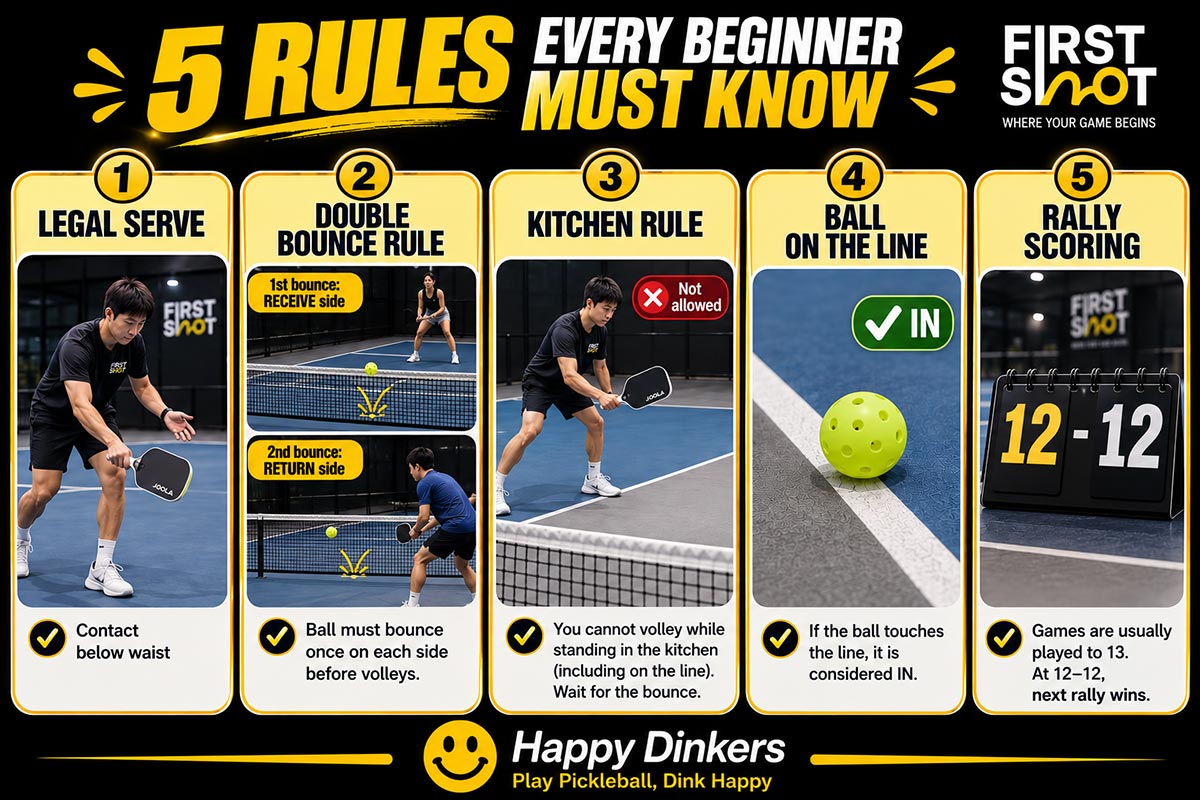
Every rally starts with a serve. A legal serve must satisfy all of these:
At Happy Dinkers, I always remind new players that a legal serve matters more than a powerful serve. A simple and consistent serve wins you far more points than a big serve that keeps landing in the net.
Rule #2
One Serve Per Player
Unlike tennis, pickleball normally gives you only one serve. If your serve lands out or into the net, the serve is lost.
The only exception is when the ball touches the net and still lands legally in the correct service court. In that case, play continues.
Rule #3
The Double Bounce Rule
This is the rule that surprises almost every beginner.
- After the serve, the receiving team must let the ball bounce.
- The serving team must also let it bounce.
- Only after those two bounces may either team volley.
This rule stops players from rushing the net immediately after serving.
Rule #4
The Kitchen Rule
The kitchen (Non-Volley Zone) is what gives pickleball a lot of its unique strategy. You cannot volley while standing in the kitchen.
But you may enter the kitchen if the ball has bounced first. A lot of beginners think the kitchen is totally out of bounds. It is not. You just cannot volley from there.
Rule #5
What Counts as "In"?
This is easy to remember: if the ball touches any line, it is IN.
Once you remember that the line belongs to the court, close calls become much easier.
Rule #6
The Kitchen Line During Serves
This one catches many beginners. During the serve, if the ball touches the kitchen line, it is OUT.
Why? Because the kitchen line is part of the kitchen. Since the serve must clear the kitchen entirely, touching that line is a fault.
Rule #7
Scoring
One of the first things new players notice is that pickleball scoring sounds a little unusual. That is because there are two scoring formats you should know about.
1) Traditional Doubles Scoring
In traditional doubles pickleball, the score is announced using three numbers:
Serving Team Score – Receiving Team Score – Server Number
For example:
5-3-2
This means:
2) Rally Scoring
At Happy Dinkers, most of our social games and many of our DUPR sessions use rally scoring to 13 points with sudden death.
With rally scoring, every rally earns one point. Unlike traditional pickleball scoring, it does not matter which team is serving. Whoever wins the rally scores the point.
The first team to reach 13 points wins the game.
If the score reaches 12???12, we play sudden death. The winner of the very next rally wins the game, which makes every point feel exciting.
We like this format because:
If you are joining Happy Dinkers for the first time, do not worry if scoring feels confusing at the start. We will explain it before the game, and after a couple of matches, it usually clicks pretty fast.
Rule #8
Calling the Ball Out
In pickleball, players call the balls on their own side. If you clearly see the ball land out, call it right away and in a loud, honest voice so everyone hears it.
If you are not sure, give your opponent the benefit of the doubt. A ball that is close is usually in.
Good sportsmanship is a big part of pickleball culture. We want players to be fair, confident, and respectful with their calls.
As a general rule, you should call the ball out immediately. If the rally has already continued and your opponent has already hit the next shot, it is usually too late to make a new out call. In casual games, you can always stop and check if everyone clearly agrees, but the best habit is to call it as soon as you see it.
Jacky???s tip
If there is any doubt at all, just play the ball. It keeps the game moving and avoids awkward arguments.
Rule #9
What Is a Fault?
Common faults include:
Whenever a fault happens, the rally ends immediately.
Rule #10
Touching the Net
Never touch the net, the net posts, or the net system during a rally. Even if you hit a fantastic winner, touching the net first loses the point.
Rule #11
Switching Sides
In doubles:
- Start serving from the right side.
- If your team wins the rally, you score a point and switch sides.
- Continue serving until your team commits a fault.
The serving rotation stays consistent throughout the game.
Rule #12
Good Sportsmanship
One reason I love pickleball is the community around it. At Happy Dinkers, you will often hear players saying, "Good shot!" even after losing the point.
Common Beginner Mistakes
After watching thousands of games, these are the mistakes I see most often:
The good news? Everyone makes these mistakes when they start.
My Advice to New Players
Do not try to memorise every rule in one day. Learn these first:
Everything else will become natural after a few games.
At Happy Dinkers, we welcome beginners every week, and experienced players are always happy to explain the rules during games. Nobody expects you to know everything on Day 1.
One more thing
If you are brand new, do not chase perfect technique on your first day. Just learn the basics, keep the ball in play, and enjoy the game. That is how real improvement starts.
Quick Pickleball Rules Cheat Sheet
If you are brand new to pickleball, here is a quick summary of the most important rules. Once you understand these, you are ready to jump onto the court.
| Rule | Summary |
|---|---|
| Serve | Serve diagonally crosscourt using a legal volley serve or drop serve. |
| One Serve | You only get one serve attempt, except when the ball touches the net and still lands legally in the correct service court. |
| Double Bounce Rule | The return of serve must bounce, and the serving team's next shot must also bounce before volleys are allowed. |
| Kitchen | You cannot volley while standing in the kitchen or touching the kitchen line. |
| Kitchen After Bounce | You may enter the kitchen any time after the ball has bounced. |
| Scoring | Only the serving team scores points in traditional scoring. |
| Winning Score | Most recreational games are played to 15 points, win by 2. |
| Ball on the Line | Any ball touching the baseline, sideline or center line is IN. A serve touching the kitchen line is OUT. |
| Net | Do not touch the net or net posts during a rally. |
| Sportsmanship | Call balls fairly and respect your opponents. |
My advice: Do not try to memorise every rule before your first game. Learn these ten rules first, and the rest will come naturally after a few sessions.
Volley Serve vs Drop Serve
Many beginners ask me which serving style they should use. The truth is, both are completely legal, and each has its own advantages.
| Category | Volley Serve | Drop Serve |
|---|---|---|
| Ball Contact | Hit before the ball bounces | Hit after the ball bounces |
| Can Toss the Ball? | Yes, even quite high | No. Simply release the ball without propelling it. |
| Contact Height | At or below the waist (navel) | No waist-height requirement because the ball has already bounced |
| Paddle Motion | Upward arc with paddle head below the wrist at contact | No upward arc requirement |
| Added Spin on Release | Not allowed | Not allowed |
| Best For | Experienced players or those who like a rhythmic serve | Beginners or players seeking greater consistency |
At Happy Dinkers, I often recommend that beginners start with the drop serve because it is easier to learn and produces a more consistent serve. As players gain confidence, many naturally transition to a volley serve, while others continue using a drop serve successfully for years.
The important thing is not which style you choose – it is serving legally and consistently.
Frequently Asked Questions (FAQ)
1. Can you toss the ball when serving?
Yes, but it depends on which type of serve you are using.
For a volley serve, you may toss the ball into the air before striking it. The official rules do not limit how high you can toss the ball.
For a drop serve, the rule is different. You cannot toss or propel the ball upward before it bounces. Just release it from your hand without adding force or spin, let it bounce on the court, and then hit it after the bounce.
At Happy Dinkers, I always tell new players to try both serving styles and use whichever feels more natural and consistent.
2. Can you slice your serve?
Yes. There is no rule preventing slice serves. You may hit topspin, slice, or flat serves.
What you cannot do is deliberately spin the ball with your hand before striking it.
3. While serving, if both my feet stay behind the baseline, can I contact the ball inside the court?
Yes. The rules only require your feet to remain behind the baseline until the ball is struck.
Your arm, paddle, or the ball itself may extend over the baseline or even over the court during contact, as long as your feet have not touched the baseline or court before striking the ball.
4. If a serve lands on the center line, is it in or out?
It is IN. The center line forms part of both service courts. If any part of the ball touches the center line during the serve, it is a legal serve.
5. If the ball hits my hand, wrist, or arm and then goes over the net, is it legal?
It depends. If the ball contacts your paddle hand below the wrist while that hand is holding the paddle, it is considered part of the paddle and is legal.
If the ball hits your wrist above the wrist joint, your forearm, upper arm, body, or your non-paddle hand, it is a fault.
A simple way to remember it: paddle + paddle hand below the wrist = legal. Everything else = fault.
Common Pickleball Rule Myths
After hosting thousands of games, these are some of the most common misconceptions I hear from new players.
Learn the Rules, Then Enjoy the Game
Pickleball is one of the easiest sports to learn. The rules may seem unusual at first, but after a few sessions they will become second nature.
My advice is always the same: focus on having fun. The skills – and the rules – will come with experience.
If you are looking for friendly games, DUPR sessions, or a welcoming pickleball community in Malaysia, come join us at Happy Dinkers. Whether we are playing at 91 Sports Arena, First Shot, or another great venue, you will always find players who are happy to help newcomers.
If you want to keep learning, you may also like these related pages:
If you are a pickleball court owner looking to host more games or collaborate with Happy Dinkers, feel free to get in touch. We are always excited to partner with great venues and grow the pickleball community together.